
Body camera footage reveals confrontation between UCPD and protesters ahead of Turning Point spectacle at UC Berkeley
April 16, 2026


UCPD body camera footage obtained via public records request
After UCPD arrested four protesters in November for felony vandalism while they were attempting to hang a giant cardboard mosquito from Sather Gate in protest of a Turning Point USA event, various campus groups began working to determine whether UCPD needed to pursue felony charges.
UCPD Chief of Police Yogananda Pittman was quick to defend UCPD’s actions that night.
Since the Nov. 10 arrest, The Daily Californian has sought out documents and footage from that night. A public records request revealed body camera footage from arresting officer Brendan Tinney which multiple legal experts say casts doubt on Pittman’s narrative.
UCPD filed charges after concluding that the roughly 28 posters allegedly pasted on Sather Gate by the protesters — three current students and one former student — would incur more than $400 in damages, meeting the bar for felony vandalism in California.
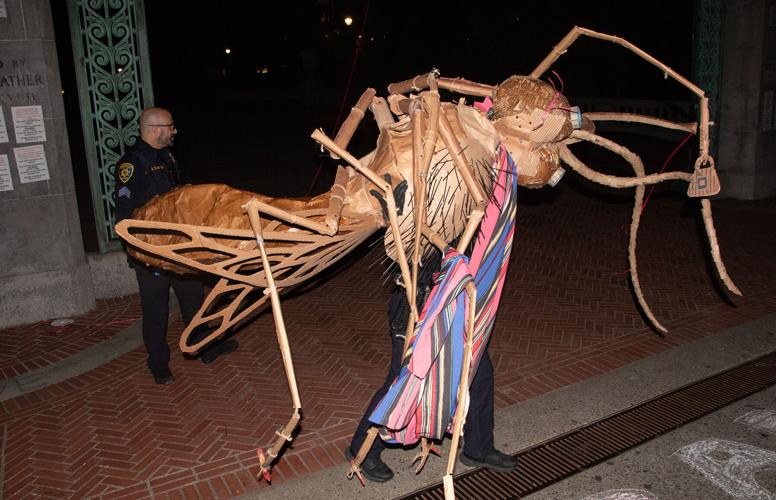 Hayes Gaboury | File
“When we heard about this we were concerned about the actual state of the students of course,” said Jonathan Simon, co-chair of the Chancellor’s Independent Advisory Board on Police Accountability and Community Safety at UC Berkeley. “But our primary concern was what seemed to us was the potential for up-charging.”
As part of its probe into the case, the advisory board sent a letter to Pittman requesting a meeting to discuss concerns over pursuit of felony charges Nov. 21.
When a response came Jan. 13, the Alameda County district attorney had already rejected charges against the four protesters. However, campus had taken up its own separate case against the enrolled students through the Center for Student Conduct, or the CSC.
“UCPD personnel acted swiftly and appropriately throughout the entirety of the contact with the involved individuals and afforded them dignity and respect,” Pittman said in her letter responding to the advisory board.
However, after reviewing the body camera footage, half a dozen legal experts — with expertise ranging from civil rights and protest law to criminal defense and prosecution — told The Daily Californian that arresting officer Tinney appeared politically biased. In some accounts, the experts noted concerns about the arrests’ legality and Tinney’s use of force.
Multiple experts also alleged that Tinney possibly violated the students’ constitutional rights to freedom of speech and against unreasonable search and seizure.
Pittman did not directly respond to the Daily Cal’s questions, but UCPD reaffirmed its commitment to fair, unbiased and professional policing.
The UCPD officers on the scene that night, including Tinney, did not respond to requests for comment.
In response to an inquiry from The Daily Californian, campus spokesperson Dan Mogulof said UCPD is “reviewing” the incident.
Tinney wrote in the police report that was authored the next morning that he initially responded to the scene after receiving a call from an off-duty officer who reported masked individuals around Sather Gate.
UCPD later provided an account to CSC from the officer who originally reported the activity while heading off-duty, in which he said he saw two students putting posters on Sather Gate and two others nearby. That account was not included in the original police report.
Tinney noted that one of the students on the scene “was wearing a black and white checkered Keffiah, a traditional headdress commonly associated with Palestine (and recently, the pro-Palestine movement).”
As seen in the body camera footage, Tinney approaches this student first.
George Tran, a current trial lawyer and former prosecutor with the U.S. Department of Justice, wrote in his analysis of the footage that Tinney’s comment before arriving on scene and his apparent failure to confirm whether the protesters had actually pasted the flyers on Sather Gate before stopping them “strongly suggests that the stop was influenced by perceived race, religion, or political expression.”
Later in the video, Tinney told Field Operations Captain Joey Williams on the phone that the protesters are “probably loosely affiliated, one of them was wearing a keffiyeh, the rest of them were wearing hoods and COVID masks.”
UCPD did not directly answer a question about what Tinney was referring to when he identified the individual as “probably loosely affiliated.”
Tran said the stop could have violated students’ Fourth Amendment rights against unreasonable search and seizure, especially those of the protester in a keffiyeh.
“The lack of reasonable suspicion to stop her specifically is not a technicality. It is the entire constitutional premise upon which the encounter must stand or fall,” Tran wrote. “If the stop itself is unlawful, then the escalation that followed is constitutionally infirm from the outset.”
Ben Nisenbaum, a Bay Area civil rights lawyer, wrote in an email to The Daily Californian that he saw political bias in Tinney’s actions. However, contrary to Tran’s account, he added that officers appeared to have caught the arrested protesters red-handed.
According to Nisenbaum, there remained enough suspicion for a valid stop. Officers also collected evidence that the protesters had committed the alleged crime after stopping them, including a confession from one of them that they had put up the posters.
Legal experts who reviewed the video said the force Tinney exercised appeared excessive, especially when he initially grabbed the first protester’s arm.
“He should not have put his hands on them. There was zero reason to use any force against any of these kids,” said Jayme Walker, a lawyer with expertise in police misconduct, in an email. “Officers may use reasonable force to enforce compliance when a person resists a lawful order, but I didn’t see any resistance by anyone and his orders were not lawful.”
Of the multiple experts that The Daily Californian spoke with, only one — former officer and expert on police conduct Roger Clark — defended Tinney’s use of force, saying “it would not rise to the level of concern.”
Most experts also said Tinney’s remarks were unprofessional despite not violating department policy or law.
“It seemed to me that he was personally offended that the students’ message was directed at the Turning Point USA event which was going to be held the next day on campus,” said Rachel Lederman, senior counsel at the Partnership for Civil Justice Fund, in an email. In reference to Tinney’s language, Lederman said, “I got the impression he really dislikes students, which is disturbing coming from a UC officer.”
While on the scene, Tinney estimated that cleanup of the 28 posters would exceed $400, placing the crime beyond the bar for felony vandalism in California.
Tinney wrote in the police report that he found flour and water on the scene, which he says could have made a rudimentary paste for the posters.
“Despite its innocent nature, the mixture of flour and water can be very troublesome to clean up, as anyone who’s worked with wheat flour-based doughs can likely attest,” Tinney wrote.
A cost report from UC Berkeley Facilities Services shows that cleanup cost campus $1,644.50.
“Per statute, if the value of the damage perpetrated exceeds $400, the law mandates a felony charge,” Pittman said in the letter. “The idea that UCPD’s adherence to the requirements of the law was in any way ‘disproportionate’ is not well taken, but more importantly, is belied by the language of what the law requires.”
Legal experts, however, said officers have broad discretion in what to charge an individual, particularly in the case of vandalism. In California, vandalism is a “wobbler,” a crime which may be filed as either a felony or a misdemeanor. Many experts said UCPD could have pursued a misdemeanor or even no charges at all.
The Demonstrations and Student Action Committee of the UC Berkeley Division of the Academic Senate, which has been looking into the case since November 2025, came to the conclusion that pursuing felony charges was not necessary after speaking with campus legal counsel, according to chair Trond Petersen.
“You can guess I am quite upset,” Petersen said. “This is not a good way to spend my time for me or for the university. But it’s much worse. Think about it for the three students.”
In the video, Tinney asks the students if they want to go to Santa Rita Jail before he appears to determine the protesters have committed a felony.
“It’s not a fucking nice place,” Tinney said. Santa Rita Jail, located in Alameda County, is currently under external oversight following reports of inhumane conditions in the jail, where suicide rates once soared above that of the entirety of the Los Angeles County jail system.
UCPD’s department policy manual states that individuals arrested for a felony should be booked in the county jail according to local policy. Nisenbaum alleged Tinney’s decision to pursue felonies and send the students to Santa Rita Jail suggests that it was done “to punish the content of their speech.”
“That’s what part of the goal of putting us through this was: to make us feel afraid, make other people who see what happened to us feel afraid,” said Inigo Macey, one of the arrested protesters, who graduated from UC Berkeley in Spring 2025.
The other protesters were granted anonymity, as they cited fear of consequences relating to their unresolved student conduct case.
“While the campus does coordinate with UCPD regarding security measures, the campus issued no instructions to UCPD prior to the TPUSA event about how to enforce the law,” Mogulof said.
In Santa Rita Jail, the students described a host of terrors. One individual said they spent two hours isolated; Macey said they spent 12.
One student alleged they heard officers at the jail joking that it would be “a fun night” with so many female inmates coming in. Another protester said it was so cold they saw people putting toilet paper on their bodies to stay warm.
After their arrest, the protesters described lasting anxiety and discomfort on campus. One of them, who is set to graduate this semester, said they had concerns about obtaining their degree as the student conduct case proceeded.
That student said their case stalled after their Feb. 4 hearings. The students received a proposed outcome letter from campus April 10. In the resolution letter, Center for Student Conduct Interim Co-Director Michael Mann says the case had fallen behind due to requests for additional information from campus.
One of those requests produced the previously unheard account of an officer saying he witnessed the protesters putting up posters.
Mann determined that the students had more than likely violated policy 102.04 in the Student Code of Conduct, which prohibits “damage to any property of the University.” The students may contest the finding and request formal hearings, or accept it and the proposed punishment.
If the students accept, that would mean disciplinary probation until May 14, 2027, or until conferral of degree, and the completion of a reflective activity on the principles of community at UC Berkeley.
The protesters arrested that night said in interviews and statements given prior to the resolution offer that they were still living with the impacts of the arrest after five months of turmoil.
One of the students said their initial trauma from the incident had transformed into frustration with campus.
“If anything, this night has honestly propelled me into a mindset of freedom and bravery that I was not in before,” the student said. “Honestly, I do not think it scared me … or made me want to leave organizing spaces.”
Mogulof said campus could not comment on specific student conduct cases due to student privacy laws. He added that the pursuit of discipline through the conduct center is a separate and unrelated process to criminal charges put through by UCPD.
The Daily Californian is releasing the full body camera footage. Watch it here.Luca Vicisano contributed to this report.
About this story
This project was developed jointly by the Data Department and the News Department at The Daily Californian.
Support us
We are a nonprofit, student-run newsroom. Please consider donating to support our coverage.
Copyright © 2026 The Daily Californian, The Independent Berkeley Student Publishing Co., Inc.